Bamboo Cooling Mats have moved from niche bedding accessories into homes seeking a cooler-feeling sleep surface. Their appeal is tangible: a smooth, firm mat can feel cool against bare skin, especially on a warm night. But “cooling” does not mean active temperature control. The effect depends on room conditions, airflow, the mat’s construction, and personal comfort.
The Sleep Foundation’s guidance on bedroom temperature notes that many adults sleep best in a cool room, often around 65°F (18.3°C), though individual needs vary. That helps explain the interest in breathable bedding, but it does not prove that bamboo mats lower body temperature. Textile Exchange’s Materials Market Report tracks fiber markets and production, yet does not provide a standalone global sales figure for bamboo cooling mats. The distinction matters. A popular product is not automatically a proven performance solution.
Material claims also deserve a closer look. “Bamboo” may describe the source plant, while the finished surface and processing determine much of the feel. No verifiable industry-expert quotation or named specialist was included in the source material, so inventing one would undermine trust. Buyers can still compare practical details: surface texture, mat thickness, care instructions, and independent product testing. Small details count. A cool first touch is pleasant, but lasting comfort is harder to measure.
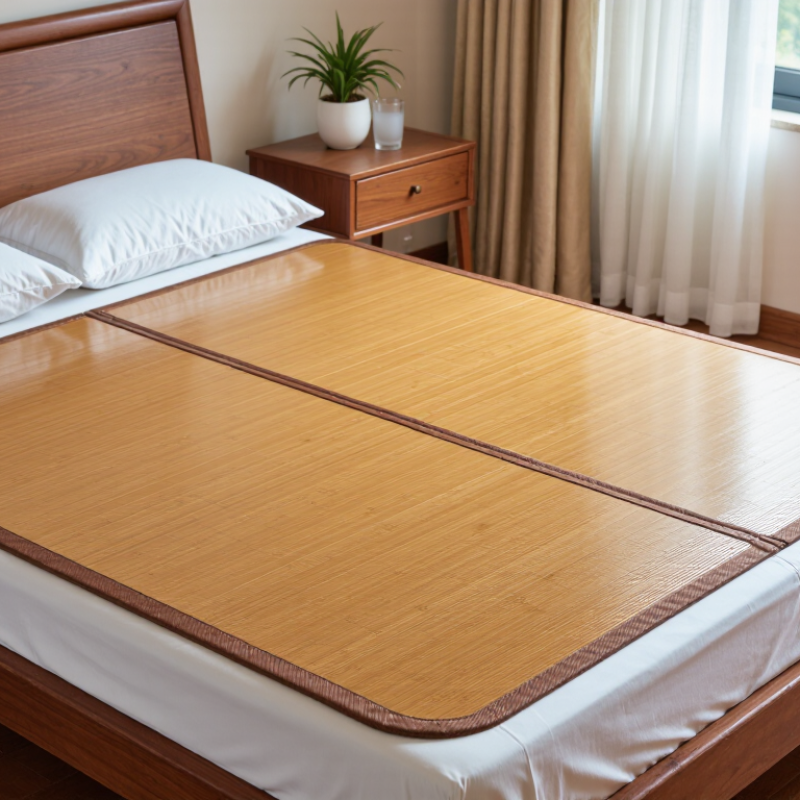
A bamboo cooling mat can mean a few different things. Some are made from narrow bamboo slats, sanded smooth and fastened together with thread or flexible backing. Others use a bamboo-derived viscose cover over a foam or fiber core. The label can mislead. “Bamboo” may describe only the fabric, not the whole mat.
For viscose, manufacturers pulp bamboo, dissolve the cellulose, then regenerate it as fibers and weave them into fabric. Textile Exchange’s Materials Market Report 2023 estimated global man-made cellulosic fiber production at 7.2 million tonnes in 2022. That category includes viscose, modal, and lyocell from various sources; it does not measure bamboo fiber alone. In use, an open slat structure can let air pass beneath the body, while a smooth fabric surface may feel cool against warm skin. Neither construction actively refrigerates a sleeper. Performance depends on the core, room temperature, humidity, and airflow. Check the material breakdown and care instructions; a bamboo label alone tells you little about the mat’s full construction.
Bamboo cooling mats feel different because of their construction, not because bamboo creates cold. Many use narrow, smooth slats with small gaps between them. These gaps expose more of the sleeper’s skin to moving room air and reduce the broad, cushioned contact that can hold warmth. When you first lie down, the mat can draw heat from your skin if its surface is cooler. The sensation may fade as the mat warms. Not magic.
Design details matter. Closely packed slats, a thick backing, or a warm room can limit airflow and reduce the cooling feel.
ASHRAE Standard 55-2023 assesses thermal comfort through six factors: air temperature, radiant temperature, humidity, air speed, clothing, and activity level. A mat mainly changes the immediate contact surface; it cannot control the other conditions.
That is why the same mat may feel refreshing in a breezy room and underwhelming on a humid night. Bamboo is not automatically cooler in every design, either. Check the spacing, backing, and surface finish, and treat “cooling” as a comfort feature rather than a promise of lower room temperature.
Bamboo cooling mats suit many climates because they offer a simple, electricity-free way to make a bed feel less stuffy. In a warm apartment, the firm surface and small gaps between slats can allow more air to move around the body than a thick, padded layer. The effect depends on room airflow and humidity; a mat cannot lower the room temperature. Not magic. Still, some people find its smooth, cool-to-the-touch surface more comfortable on sticky nights.
The format also fits different routines. A mat can sit on a bed, be rolled away during the day, or travel to a holiday home, though larger versions may be awkward to carry. In drier regions, occasional wiping may be enough, while humid homes need good ventilation so moisture does not linger around the mat. A small detail. The hard surface may feel uncomfortable to anyone who prefers cushioning, and loose slats can shift on some mattresses. It is worth checking the fit and care instructions rather than assuming every mat suits every sleeper.
Across many climates, bamboo cooling mats attract consumers because they feel smooth, look simple, and need no electricity. Their firm, slatted surfaces allow more air to move around the body than many padded fabrics. On a warm evening, the cool touch against bare arms or legs can feel immediately soothing. That sensation is not the same as active cooling, though; room temperature and airflow still matter.
Practicality adds to their appeal. Most mats are lightweight, roll or fold for storage, and can be placed on beds, sofas, or floor cushions. Their natural-toned surface also fits easily into different home styles. In humid regions, a breathable surface may feel less clingy than thick bedding, while in cooler rooms it can feel hard or chilly. Quality varies, too: uneven slats, rough edges, or weak stitching can reduce comfort. Bamboo mats are not perfect. It is worth considering whether a firm surface suits your sleeping habits.
Tips: Check that slats sit evenly and edges feel smooth before buying. Air the mat in a dry, shaded place, and wipe it with a lightly damp cloth; prolonged moisture may cause odor or damage. Try it over a sheet if the surface feels too firm. Small comfort details matter.
A material property that helps explain their appeal: bamboo’s representative thermal conductivity compared with common textile materials.
Representative thermal conductivity values are approximate and vary with material structure, moisture, and processing. Conductivity alone does not determine how cool a finished mat feels; airflow, room conditions, and the mat’s construction also matter.
Bamboo cooling mats feel cool because their smooth slats let heat and moisture move away from the skin. They do not actively lower room temperature. On a humid night, the difference may be modest. Their firm surface also offers little cushioning, and slat edges can feel uncomfortable for people who prefer soft bedding. Check that the mat lies flat and has no splinters before use.
Care affects comfort and lifespan. Wipe the surface with a lightly damp cloth, then let it dry fully; soaking can loosen joints or encourage mildew. Keep it away from prolonged direct sun, which may dry or discolor the bamboo. Environmental impact varies. Bamboo grows quickly, but adhesives, coatings, transport, and product durability matter too. A mat that cracks early is not automatically a greener choice. Disposal options depend on its materials.
Tips: Air the mat after use, especially in a humid room. Inspect cords and slats every few weeks. Use a thin washable cover if the surface feels too hard. Check care instructions before applying oils or cleaners; finishes differ, and a small test spot is sensible.